EXPLORE THE ASIAN GAME
Football through an Asian lens.


Southeast Asia suddenly has two regional championships competing for space, relevance and identity. But while the region must raise its ambitions beyond its own borders, Keeshanan Sundaresan and Dez Corkhill argue that the answer cannot be to sacrifice the competition, culture and connection that makes ASEAN football matter.
Asia has always been one part of the world that has placed an increased value on international football, for a whole host of reasons, many of which are cultural within a populace that is rooted in national pride
Nowhere is that more pronounced than Southeast Asia, whose biennial regional tournament – now known as the ASEAN Championships, or Hyundai Cup to give it its sponsored name – has developed over three decades to take pride of place on their international football calendar.
So in theory, the idea of a second regional tournament is one that would be welcomed; more meaningful games, more packed stadiums and more opportunities for countries to compete for silverware.
And yet, after a period in which Southeast Asia staged two regional championships in little more than two months, the overwhelming feeling is not necessarily one of celebration – it’s of confusion.
The traditional ASEAN Championships has spent almost three decades establishing its place within the region, having first been staged back in 1996.
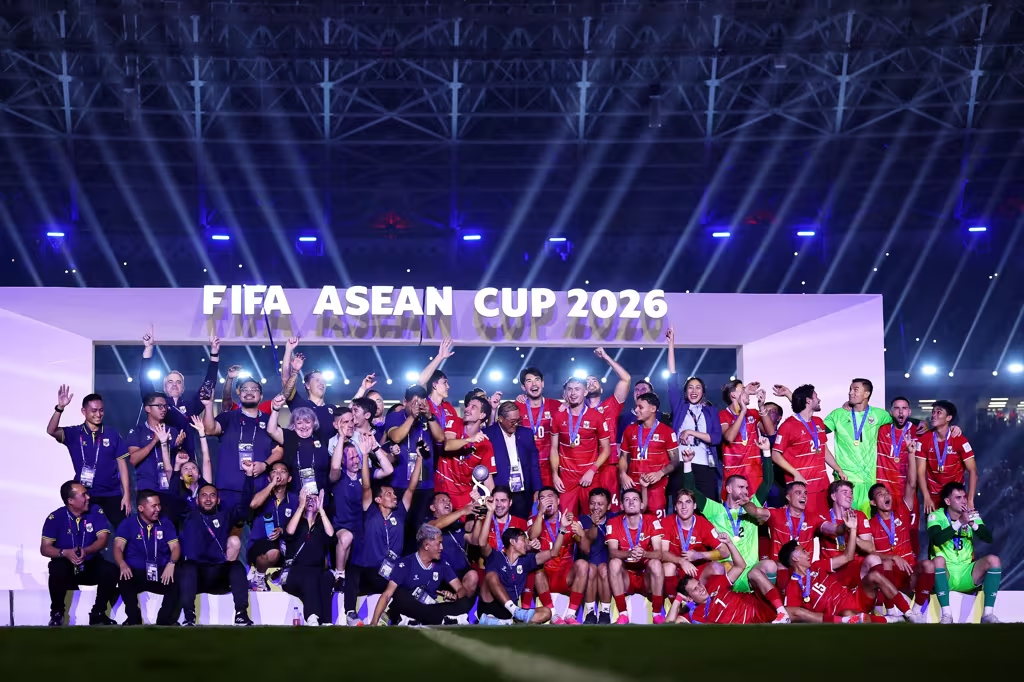
Now there is the new FIFA ASEAN Cup, with invited teams from outside the region and staged within the international window and therefore capable of attracting something the existing competition has increasingly struggled to guarantee in recent editions: the strongest possible squads.
In isolation, there was plenty to like.
For Malaysian football pundit Keeshanan Sundaresan, the appeal of seeing Southeast Asian nations at something close to full strength was obvious.
“I wanted to be excited about it and, to be fair, there were parts of the tournament where I was genuinely excited,” he said this week on the debut episode of The International Window.
“If we were to look at it purely from a game point of view, there were some really exciting games. It was entertaining stuff.
“I think what made it fun is because it’s a tournament within the FIFA calendar. It allowed us to see the strongest versions of these teams because, in past Southeast Asian tournaments, it’s always difficult to get that right.
“As a standalone tournament, did it provide entertainment? Did it provide drama? Did it provide talking points? Yes. But where does it belong in the grand scheme of things? What does it do for Southeast Asian football? Does it move the needle? Does it accelerate the growth towards a specific direction? I’m still figuring that one out.”
That is ultimately the question around which everything else revolves.
While more competitive international football is welcomed, which is part of the reasoning behind the proposed AFC Nations League, the issue is whether Southeast Asian football actually needs another competition that essentially asks the same nations to play one another for another regional title.
I mean, who do we even classify as ASEAN champions? Is it Vietnam, who won the ASEAN Championship in August? Or is it Indonesia, who won the FIFA ASEAN Cup earlier this month?
In a region where bragging rights matter, understanding who has them is key.
For Dez Corkhill, who has spent more than two decades covering the game across Southeast Asia, the answer was far more emphatic.
“It angered me that there were two tournaments,” he said.
“The football itself in both competitions, for different [reasons], was very good. But the fact they actually took place in the same year was bad enough. Within a month of each other just made me [think], what is the point of this?
“To me, it just made no logical sense whatsoever.”
That becomes particularly pertinent at a moment when Asian international football is becoming increasingly congested.
The proposed Nations League potentially adds another layer of competitive football into an already congested calendar, and where regional tournaments fit into that is one question that is yet to be answered.

International windows are valuable real estate. If Southeast Asia is going to occupy a significant portion of them by repeatedly playing itself, there needs to be a clear developmental reason for doing so.
Sundaresan sees a potential answer, but only if the two tournaments can be made fundamentally different.
“The biggest question is always, from a Southeast Asian football point of view: what is the goal?” he said.
“There are two things: you would want a tournament that genuinely celebrates Southeast Asian football, fandom, football culture, everything that exists in this region, and for a very long time it always felt like the ASEAN Championship was the perfect example of that.
“But then comes the other goal, which is for Southeast Asian nations to break out of the shell of this region and to advance further, to start challenging the bigger boys. You need frequent fixtures and competitive games against the bigger boys.”
There, perhaps, is the distinction the FIFA tournament needs to find. If it merely becomes another version of the ASEAN Championship, there is little justification for its existence.
If, however, FIFA’s involvement can create a platform through which Southeast Asian nations regularly face stronger opposition from elsewhere in Asia, then there is at least a broader purpose.
Whether that would garner public support, and put it on a level with the ASEAN Championships, is another question entirely, however.

“I don’t think that there needs to be space for two Southeast Asian tournaments,” Sundaresan added.
“But if you are going to have two, you need to draw genuine lines to differentiate between what the purpose of these tournaments are.
“One has to celebrate Southeast Asian football, and I think that mantle belongs to the ASEAN Championships. The other has to serve a completely different purpose, which right now we don’t know what that is yet.”

That second purpose matters because the ambitions of Southeast Asian football are changing.
Indonesia has invested heavily in creating a national team capable of competing deeper into World Cup qualifying, while Vietnam and Thailand have long sought to establish themselves beyond the confines of the region.
The Asian Cup, rather than the ASEAN Championship, increasingly has to become the measuring stick and on that front four nations – five if you generously include Australia – will represent the region in Saudi Arabia, being Indonesia, Thailand, Vietnam and Singapore.
Ultimately, beating your neighbours only tells you so much about your ability to compete with Japan, Korea Republic, Australia, Iran, Saudi Arabia or the emerging powers of Central and West Asia.
And on that front, no team from Southeast Asia is yet to make a serious impression at the Asian Cup, at least in recent times.

That does not mean regional success becomes irrelevant, instead it means it must increasingly become a platform rather than a destination.
There was a revealing moment in Indonesia’s recent trajectory, Sundaresan argued, when a side that had made progress by embracing the mentality of an underdog suddenly began behaving like an established continental power.
“I felt that Indonesia sort of treated themselves as a big gun a bit too soon,” he said.
“What worked well for them under Shin Tae-yong was that, despite the new additions into the team, they still played on the pitch like an underdog.
“We still don’t underestimate our opposition. We still keep it tight defensively, look to attack the team on the counter and pick up wins in that way.
“But the moment they started to look at themselves as one of the big guns, as a dominant force, it started to not work quite well.”
That is a fine balancing act, as confidence shouldn’t necessarily be seen as a negative. But ultimately, it’s what these nations do beyond the borders of the region that will determine their status on the continent more broadly.
Indonesia winning the FIFA ASEAN Cup will mean nothing if they bomb at the Asian Cup in January.
That is only half the argument.
Because the easiest solution – scrap regional competition, play stronger opponents and force every nation to raise its level – ignores something fundamental about football.
People need to believe they can win.
“You’ve got to give people a chance to succeed,” Corkhill said.
“You’ve got to have a chance to win. Otherwise, if you’re getting hammered all the time, you lose the motivation. The leagues lose interest. The publicity within the national areas is negative the whole time.
“I still remember when Malaysia won the ASEAN Championship, this country went nuts, absolutely nuts. The whole place stopped because everybody loves to win.
“If you win at a regional level, it gives you a chance to move on to the Asian level.”
That is especially important when considering the very different stages of development across Southeast Asia.
Indonesia’s goals are not Laos’ goals. Vietnam’s expectations should not necessarily be Timor-Leste’s expectations.
For Cambodia, Myanmar, Laos or some of the region’s other developing nations, regional competition can provide something that matches against Asia’s elite simply cannot: realistic opportunity.

Opportunity to win. Opportunity to build support. Opportunity to create enough public and political interest that investment in the sport appears worthwhile.
“If year in, year out they just keep being battering rams, then at no point will they get any sort of political will in these nations to want to pump money into football, to want to grow the sport,” Keesh said.
“If you’re just getting smacked six-nil, five-nil, three-nil, the fans will not turn up to the ground.
“And if the fans don’t come and the fans don’t care, then at no point will the people in positions of power have any motivation or desire to want to grow the team.”
One idea that was introduced for the FIFA Asean Cup, that Sundaresan and Corkhill both support, is the idea of a two-tiered tournament to give the developing nations hope for success against nations of a similar level.
“The idea that there were two divisions, I actually quite like that idea,” Corkhill said.
“And the idea of inviting other nations in, I like that idea… you need to be competitive. That’s why the ASEAN [Championships] is so important to keep alive, maybe with two divisions, so that they have a chance to be competing and giving their supporters some kind of hope of some kind of success.”
There is also something more intangible at stake.
The traditional ASEAN Championship has created something Asian football routinely struggles to manufacture elsewhere: genuine local rivalry, accessible away travel and packed stadiums filled by supporters who care deeply about the outcome.

Malaysia against Indonesia means something. Thailand against Vietnam means something.
Those emotions cannot automatically be replicated by inserting Bahrain, Jordan or another similarly ranked nation into a Nations League draw.
“If Malaysia are drawn against Bahrain, you’ll get a crowd of maybe 10,000, maybe 20,000,” Corkhill said. “If Malaysia are drawn against Indonesia, you’ll get 50 or 60 [thousand].
“You take away that local derby element, that local regional element, at your peril. Football is about winning, but it’s also about the fans and belonging.”
For Sundaresan, the home-and-away structure that has traditionally characterised the ASEAN Championship is an equally important part of its appeal.
“One of the best things about the ASEAN [Championships] was the home-and-away format,” he said.
“It was absolutely incredible because Southeast Asia is a very unique region in a sense where everyone is close to one another.
“The experience of following your nation on an away game is something that you would not be able to get if, let’s say, Malaysia would frequently go and play a Middle East nation as part of the Nations League, or frequently play China, Japan, Korea, Mongolia, Australia, whoever it is. Those trips are just too expensive for local fans to be a part of.
“After one edition, you can already see the growth of an entire new generation of fans who have spent the last month travelling to at least one or two away games and going to these home games.

“It’s almost like a carnival atmosphere for an entire month, and you cannot sacrifice that.”
And perhaps that is ultimately where the answer lies.
Southeast Asia does need to look outward. Its strongest nations need more regular exposure to better opponents, and its ambitions should increasingly be measured at Asian Cups and through World Cup qualifying rather than purely by regional supremacy.
But development cannot simply mean abandoning the ecosystem that gives Southeast Asian international football much of its relevance in the first place.
The ASEAN Championship still has purpose and meaning – significant ones.
The challenge now is to protect what makes it special while finding meaningful ways of pushing the region beyond it.
Because the question for Southeast Asian football should no longer simply be whether it can produce another regional champion. It should be whether winning in Southeast Asia can become the starting point for something bigger.