EXPLORE THE ASIAN GAME
Football through an Asian lens.


A decade ago, Australian clubs were broadly comparable to their Asian rivals in age and overseas experience. Today, younger, leaner A-League squads face increasingly experienced and internationally assembled opponents, particularly in Southeast Asia. The numbers expose a widening divide, but the bigger question is whether Australian football still has the ambition to close it.
Sydney FC’s loss to Lion City Sailors in the semi-final of the AFC Champions League Two back in April of last year was perhaps the canary in the coalmine.
Historically, an Australian club facing Singaporean opposition would be considered a lop-sided affair. But Sydney’s loss over two legs represented a changing of the times, where ambitious club sides from Southeast Asia had surged ahead of cost-cutting A-League teams.
Since then, two other A-League clubs have been eliminated from continental competition – Melbourne City in AFC Champions League Elite and Macarthur in ACL Two – and both were at the hands of Southeast Asian opposition.
On the back of a fortnight in which A-League teams were once again chastened by our neighbours to the north, none more so than Adelaide United who were dismantled by Lion City Sailors 7-0 across two games, the question has to be asked as to whether A-League clubs any longer have not just the means, but the ambition and ability, to compete in Asia?
Of course, A-League teams will win games. Earlier this campaign Melbourne Victory defeated K League champions FC Seoul 3-0 in Melbourne, while Adelaide United won the opening two games of their campaign, including an impressive win on the road against BG Pathum United.
And, it has to be said, both Melbourne and Adelaide are still a chance to progress to the knockout rounds, although the outlook for Newcastle is far less optimistic. So we have to be careful not to be too fatalistic, even after such a disheartening fortnight.
But winning the odd game, and being genuinely competitive, are different things and increasingly it looks as though A-League clubs, in their era of austerity, are being left behind by ambitious, resource-rich clubs across Southeast Asia.

Both Newcastle Jets coach, Mark Milligan, and his counterpart in Adelaide, Airton Andrioli, have this week lamented a lack of investment – and not just financial – in the game in Australia.
It’s not a matter of simply paying players more, although that is a factor when it comes to attracting foreigners – it’s more about investing in the game.
“You’re seeing now the difference in terms of what we’re coming up against – squad sizes, squad values,” Milligan said.
“There’s so many things there but that doesn’t mean we shouldn’t be able to compete.
“The only way I see us being competitive is not a financial point in terms of teams individually. I think it’s a financial point from the league – we have to play more games.
“We have to start earlier. We can’t start when we do and expect teams to be competitive in this competition.
“You see a shift in the quality you get when you come up against Japanese teams now that they’ve shifted the time of their league. When I was coming through, we used to play the Japanese teams in the ACL when they were in pre-season.
“They’ve shifted their game to winter and it’s gone to another level.”

While the problems are easy to identify, it’s worth reflecting on just what has changed in recent years for such a sudden change, and there are two obvious ones.
The first is financial. From its halcyon days in the early 2010s – the era in which Western Sydney Wanderers actually won the ACL – club finances have been hollowed out.
A news report from 2016 broke down the spending of A-League clubs, which concluded some of its biggest clubs were spending in the vicinity of $5 to $9 million per season on wages. The biggest spenders were Melbourne City, who that season had Australian legend Tim Cahill on their books.
Sydney FC were reported to be spending close to $6 million, and Melbourne Victory $5 million, in an era when the salary cap was set at just $2.65 million, albeit one with a number of exemptions.
Ten years on, that cap limit is largely the same, although it must be said there is no current CBA between the clubs and PFA prescribing that limit. Australian Professional Leagues (APL), who manage the league, proposed a hard cap of $3 million with just one marquee exemption, but that has not yet been agreed.
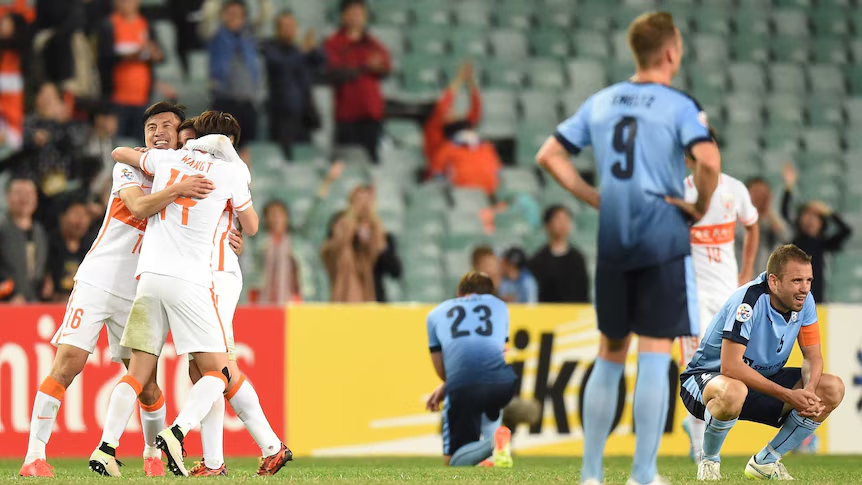
The timing of that report is relevant, because 2016 was also the season that both Melbourne Victory and Sydney FC advanced from the group stage of the AFC Champions League; one of the rare successful seasons for Australian clubs over the past decade, albeit both were narrowly eliminated in the Round 16.
A breakdown of data around the age profile and squad composition between that season and now reveals some significant changes.
That, of course, was in the era of the AFC’s 3+1 rule, in which clubs were limited to fielding just three foreign players, or four if one was from a fellow AFC nation.

When comparing the starting XIs of both Sydney and Melbourne, compared with the other 14 nations from East Asia, a few things emerge.
The average age of both Australian clubs was 27.2, on par with the average age of the other teams (27.4). Australian clubs played, on average, 2.5 foreign players in their starting XI, marginally higher than the 2.33 average for the other 14 teams.
Australian clubs still tended to play more young players, with an average of 2.8 players under the age of 23, compared to just 1.0 for the other teams.
That has dramatically changed a decade on, however.
With clubs now spread across two competitions, which wasn’t the case in 2016, for comparison’s sake we will compare against all other teams in ACL Elite, and the six other teams in the ACL Two groups of Melbourne Victory and Adelaide United.
The average age of Australia’s three teams is now 25.8 (down from 27.2), compared to 29.1 of their opponents (up from 27.4). The biggest change, though, has come in the foreign player rules, with the 3+1 rule abolished, and clubs now restricted only by their own domestic limitations.

In Australia, that still limits teams to five foreign players, but elsewhere there is almost open slather, especially across Southeast Asia.
While A-League clubs still only average 2.90 foreigners, that is now 4.95 across the other 21 comparison clubs. While that doesn’t seem like much, that average is reduced given how few foreigners clubs in Japan and South Korea often use.
Kashiwa Reysol, for example, hasn’t fielded a single foreign player this campaign.
When compared with clubs across Southeast Asia, the real disparity emerges. Their clubs are now, on average, older (29.7) with an average of 6.9 foreigners per XI. Some clubs, like Lion City Sailors, JDT and Buriram United, often field starting XIs fully comprising foreign-born players.
Finally, Australian clubs are now averaging 4.3 players under 23 (up from 2.8 in 2016), while that number across the other 21 clubs has dropped to just 0.5, and even fewer (0.3) across just the Southeast Asian clubs.
Comparing total squad sizes is an imperfect science, especially when looking back a decade, but it is a safe generalisation, especially compared to Southeast Asia, to say those clubs have deeper and more experienced squads than either Newcastle, Melbourne or Adelaide.

JDT, for example, list 40 players on their website, and Buriram United 35. While Lion City Sailors and Persib Bandung both list 28, more in line with A-League squad sizes, the depth of quality is what sets them apart.
“Boys against men tonight,” was Andrioli’s assessment after Adelaide were humbled 5-0 in Singapore this week.
“That’s something we (all) need to take responsibility for. We all need to grow together.”
Asked about the gap between A-League clubs and their Southeast Asian neighbours – which is surely now the reverse of what once existed – he remarked:
“That’s a tough question for tonight after such a bad result… clubs in Asia are investing really well. If you don’t invest in football, your football will go backwards. So in that regard, Asia has done well (when) you see the progress of those teams.”
There are legitimate questions around whether fielding so many foreign players is helpful for the development of the game within those nations, and their respective national teams.

Asian football commentator, Rhysh Roshan Rai, posed the question on social media of whether that was the remit of clubs, however, or whether they should just be concerned with winning and success.
“Not been a good week for Australian clubs against ASEAN teams,” he wrote, “but there’s a good discussion to be had I think.
“Look at the composition of the lineups. On one hand you could say more HG [homegrown] talent is playing for Aus clubs, but on the other, should clubs care about that at pro level?
“I don’t really have an answer as I can see arguments for both sides of it but it’s nice to hear different perspectives.”
The intangible, that cannot be quantified, however, is just how much value is placed on success in Asia.
In their era of austerity, there is an appearance and perception of clubs being happy just surviving, rather than thriving. That is the case in the domestic context as much as the continental one. Clubs will talk about wanting to be successful in Asia, but there are few actions to back up the rhetoric.
While there are mitigating factors, the often paltry attendances in Australia also give credence to claims of disinterest among Australian clubs. Behind closed doors that might not be the case, but perception is often reality.

In Southeast Asia, ambition abounds and across the whole club, from staff and players to fans, playing and winning in Asia matters. There is a great sense of pride taken from that.
The bonafides of JDT and Buriram United have long since been established, but there is a growing number of clubs that are showing ambition, not just in rhetoric but in action.
From Lion City Sailors in Singapore, to Persib Bandung in Indonesia – with their repatriation of a number of Dutch-born Indonesian internationals – and even clubs like PKR Svay Rieng in Cambodia, who after back-to-back AFC Challenge League finals, are on track for a spot in the knockout rounds of ACL Two and have become a flagbearer for Cambodian football.
The biggest question is whether the tide can be turned around?
“Australian players are good enough,” Milligan said when asked what lessons can be learned.
“(But) it’s hard work and it takes time. We have to continue to learn. We have to continue to grow. We have to continue to accept the lessons and the reasons why results are going the way they’re going.”