Palestine’s football team has continued to defy the odds to deliver on the pitch, aiming to aid their people’s adversity.
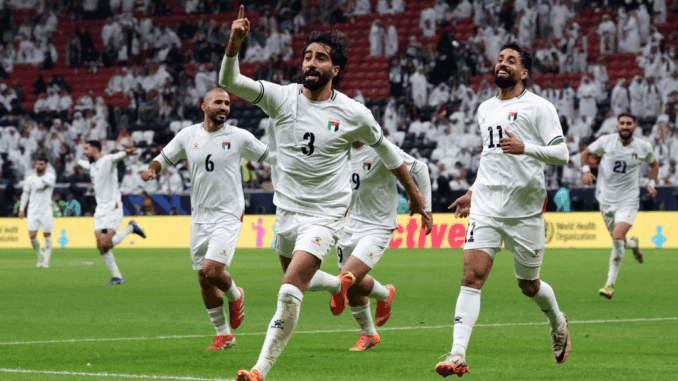
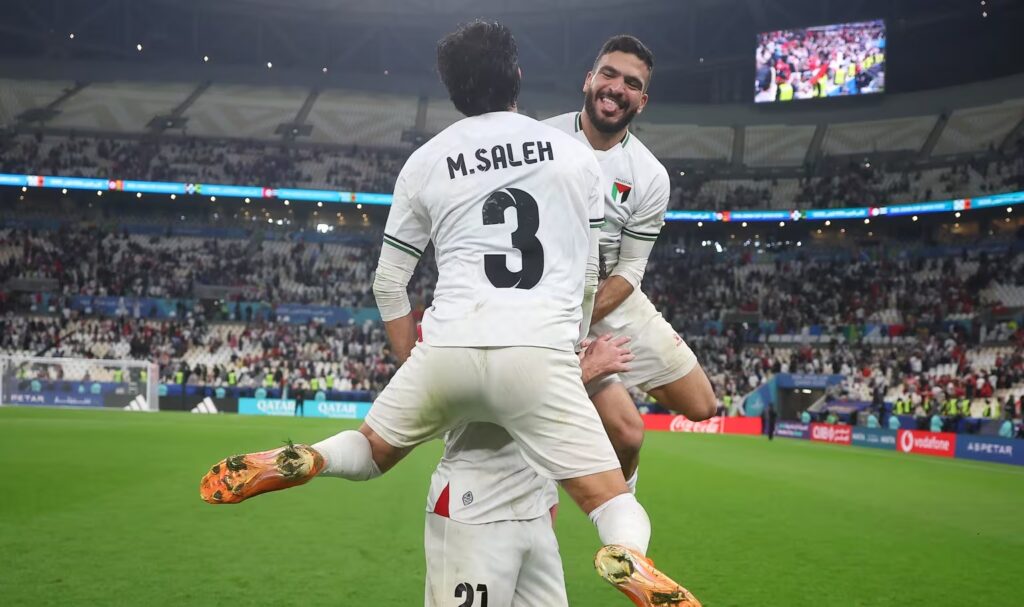
As soon as Qatari full-back Sultan Al-Brake’s attempted clearance ended up in his own net, Mohammed Saleh tore away from his teammates as if propelled by something outside himself. He sprinted alone toward the corner of the pitch, fists clenched, chest puffed, roaring into the sea of Palestinian flags in the stands.
The others caught him eventually, bundling him beneath a tangle of limbs, but it was his reaction that lingered: all fire and release, as though the imminent final whistle would open a crack in the world and, for a moment, he could breathe again. It was his flicked header that would eventually lead to Palestine’s first win against hosts Qatar in over two decades, in latter’s own backyard no less.
For most teams and players, the eruption would have seemed outsized for a group-stage victory. For Saleh, the 31-year-old defender from Gaza, it felt like catharsis.
It was here in Qatar, almost two years ago, that emotions had spilled out in a different form for him. As soon as Palestine secured their first-ever win at the tournament, a 3-0 win over Hong Kong, and with it a spot in the knockouts of the AFC Asian Cup, Saleh broke down in tears, weeping uncontrollably under the floodlights.
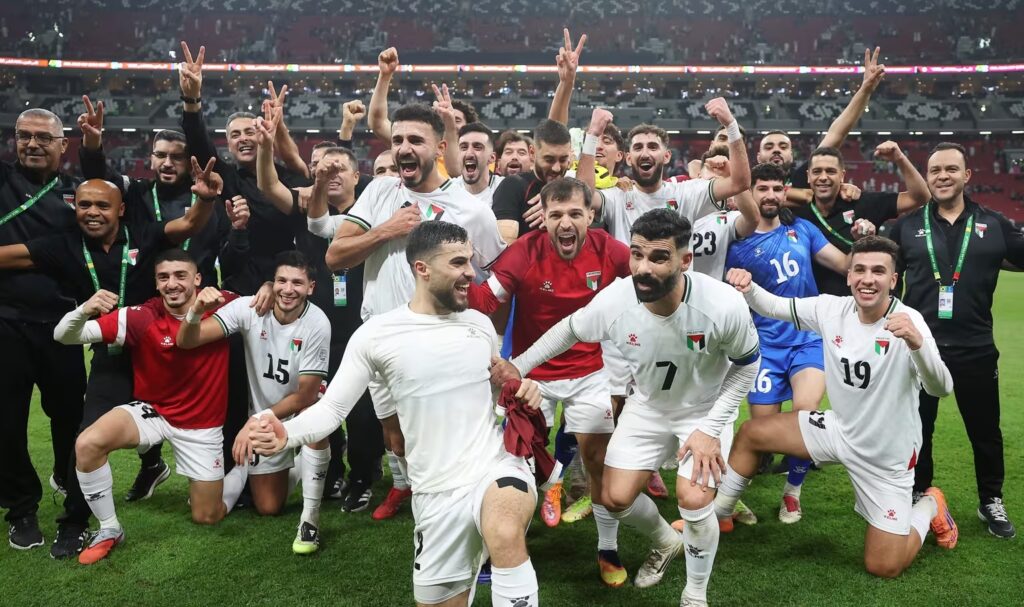
Even victory and the historic moment could not shield him from the dread. He had been trying, and failing, to reach his family back home for days. His friends killed, bombs falling relentlessly on his people, Saleh could not hold it any longer: “I hope they find out…,” Saleh later said, before shedding tears again.
That duality of joy and anguish braided into something fierce has defined Palestine’s football since Israel’s attacks on Gaza started in October 2023, which has been declared a genocide by the UN Independent International Commission of Inquiry on the Occupied Palestinian Territory, and by multiple international genocide scholars.
And the team has defied odds, soaking up the off-the-pitch support to salvage results in clutch situations.
Since that historic night in Abdullah bin Khalifa Stadium in early 2024, a lot has changed. Palestine have only continued to grow stronger, despite the bombings affecting every imaginable footballing factor.
They manoeuvred themselves to the edge of something unprecedented: a place in the final round of World Cup qualifying, holding South Korea twice, as well as a set of other gritty performances. They have found results that, on paper, they had no business finding.
So when half-time of the qualifiers for the FIFA Arab Cup came against Libya, head coach Ihab Abu Jazar unleashed an impassioned speech to his player that has since become nothing short of a lore in a short few days.
“Forty-five minutes,” he told them, his voice rising and cracking in equal measure. “Don’t forget who we play for. People in the tents are waiting for us: in al-Quds… people who cannot find anything to eat. You are the ones who must bring them joy, so they might forget death, war, and destruction for half an hour.”
Rather than tactics or strategy, Abu Jazar set out for a reminder of the context that has shaped this team more than any formation ever could.
Perhaps that is why even their opponents, over time, have been struck by something beyond the football. Julen Lopetegui, the Qatar head coach, sounded almost dazed by the force he had faced earlier this week.
“You have to put pressure and pull your hair when you’re on the pitch,” he said. “The first step is that — football comes later. Congratulations to them. You can lose, win, or draw a match, but your money has to be on staying at this level. To have this level of passion is the only way a team can do well.”
Passion. The word keeps coming up, as if everyone who plays against Palestine discovers the same truth. They are not, by any conventional metric, the most elegant side in Asia. Their football is pragmatic, stripped of ornament, full of running and cussed discipline. It is closer to necessity than to style. Reality makes even putting the team together an achievement.
But it is charged with something else, something beyond the tactical diagrams. A sense of duty, as Mohammed Saleh put it: they play so that their people can smile for a moment.
That idea has travelled with them at the Arab Cup, in addition to the makeshift classrooms and shelters where Palestinians gather to watch them. Footage after the win against Qatar, as has been the norm following each victory the side has managed in the past two years, is evidence that the team has manifested into something larger.
It has drawn in support from across the region, from those who see in these players not a football side but a symbol. And it has translated into holding on and converting when it matters the most.
While odds are still stacked against them on the face of devastation, occasions like Saleh’s celebration at Al Bayt Stadium serve almost as hope made flesh. As long as they’re platformed, Abu Jazar’s side seems to be finding ways to push forward, channelling the solidarity and defying reality.