
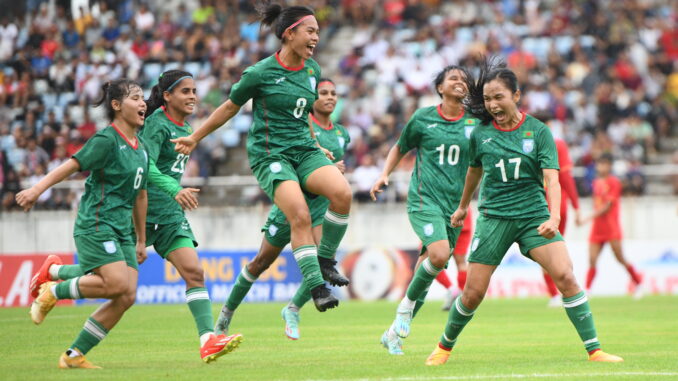
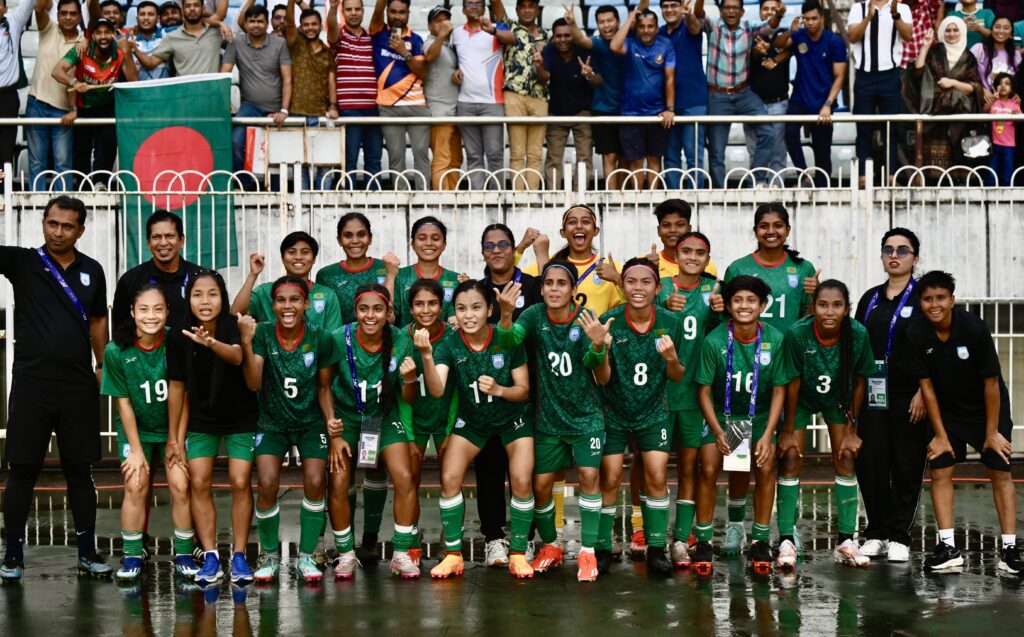
When Bangladesh qualified for the AFC Women’s Asian Cup 2026, they became the lowest-ranked nation to ever do so in the tournament’s history.
For many, it was completely unexpected, however for followers of South Asian football, it was actually the result of steady growth over several years with recent successes at the regional level before the continental breakthrough finally arrived.
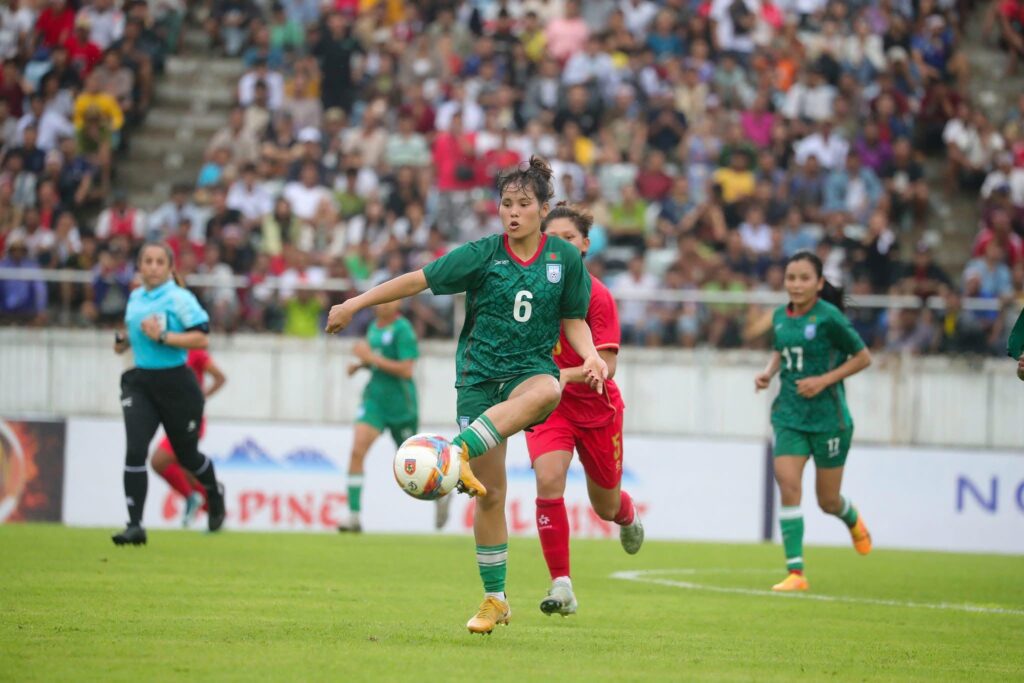
One player who has been an ever-present member of the national team in recent years is midfielder Monika Chakma. Hailing from Khagrachhari District of the Chattogram Division in Southeastern Bangladesh, she rose to become one of the nation’s most talented footballers.
“I started playing football in school tournaments at the district level in the year 2011,” said Monika in an exclusive interview with The Asian Game.
“One of the coaches liked my playing style while I was playing for my hometown team, Khagrachhari. I was then scouted by an academy and got the opportunity to play youth football at the national level.”
Laying the foundation stones
Monika’s natural talent was evident from a young age and in 2016, she burst onto the scene for the under-16 national team as Bangladesh stormed to five wins out of five to conclude a perfect AFC U16 Women’s Championship qualification campaign.
In the main tournament, Bangladesh only narrowly lost to Australia 3-2 with Monika getting on the scoresheet against an Australian side featuring current Arsenal midfielder Kyra Cooney-Cross, who was also on target that day. In a twist of fate, little did Monika know that one day she would be heading to Australia to compete in the biggest tournament in her career.
A couple of years later, Bangladesh proved that it wasn’t a fluke qualification as they scored 27 goals in just four matches and finished above Vietnam to qualify for the AFC U16 Women’s Championship in back-to-back campaigns for the first time in their history. The signs were evident that they were silently building something special.
“Bangladesh Football Federation (BFF) has worked continuously towards women’s football development since 2015. After a decade, the results are there for everyone to see,” remarked Monika.
Monika’s moment in the spotlight
Then came 2019, a very important year in Monika’s career. She was part of the national team squad for the Bangamata U19 Women’s Gold Cup, a tournament aimed at providing international exposure to the country’s budding female footballers.
In a 3-0 semi-final victory against Mongolia in Dhaka, Monika opened the scoring in first-half stoppage time in unforgettable fashion. With the ball bouncing towards the edge of the penalty area, the midfielder advanced to head the ball away from an opposition defender before arching her body to unleash an unstoppable volley into the top corner.
The goal didn’t go unnoticed with FIFA naming it in a list of Fans’ Favourite Moments, earning her the moniker “Magical Chakma” — the kind of recognition women’s footballers in the region aren’t used to. Later that year, Bangladesh produced another eye-catching result, holding Australia to a 2-2 draw in the group stage of the AFC U16 Women’s Championship.
Thinking back to those days, Monika credited a couple of former Bangladesh women’s national team footballers, citing them as inspiration.
“I have loved football since my childhood and left my home at a very young age to pursue my dreams,” she recalled.
“Several former footballers have inspired me in my journey, such as Sabina Apu (Sabina Khatun) and Aungmraching Didi (Aungmraching Marma). I used to read about them in local newspapers when I was young.”
Fast forward to the present day and Monika herself has now become an inspiration for the rising talents of Bangladesh women’s football. The youth national team has dominated the SAFF U20 Women’s Championship since its formation in 2018, winning five out of seven editions to date.
In April this year, they will follow in the senior national team’s footsteps by making their AFC U20 Women’s Asian Cup debut in Thailand, further highlighting that there’s top-quality talent coming through the ranks.
“The youth team players are getting inspired by the results of the senior national team. In every system, the senior national team has to lead the way,” stated Monika.
No rose without thorns
In every great story, perhaps perseverance matters the most and Bangladeshi women’s footballers know that all too well. There have been constant issues with women’s football in the Muslim-majority nation.
In February last year, the BBC reported about Islamist threats forcing the cancellation of women’s football matches in Northern Bangladesh, with clashes taking place in a local tournament.
Football represents a major source of female empowerment and a way out of poverty in many regions of South Asia. With the Bangladesh Nationalist Party (BNP) returning to power after winning the general elections held on February 12, it remains to be seen if such incidents involving religious hardliners will be dealt with in the near future.
“When girls used to participate in school tournaments, they were told not to play football. Thankfully, it hasn’t affected me personally (belonging to the ethnic minority), but it certainly affected the Muslim players,” shared Monika.
“However, many local coaches did support women’s football, especially after the national team’s good results. Unfortunately, the problems with social stigma are still evident in remote villages.”
An historic qualification
With political instability back home, the Bangladesh women’s national team made the trip across the border to Myanmar for their AFC Women’s Asian Cup 2026 qualification campaign.
The two-time reigning SAFF Women’s Championship winners displayed grit and resolve to defeat hosts Myanmar 2-1 at the Thuwunna Stadium in Yangon with Ritu Porna Chakma netting a brace. It was Bangladesh’s litmus test away from home against a team that had qualified for the continental showpiece on five previous occasions.
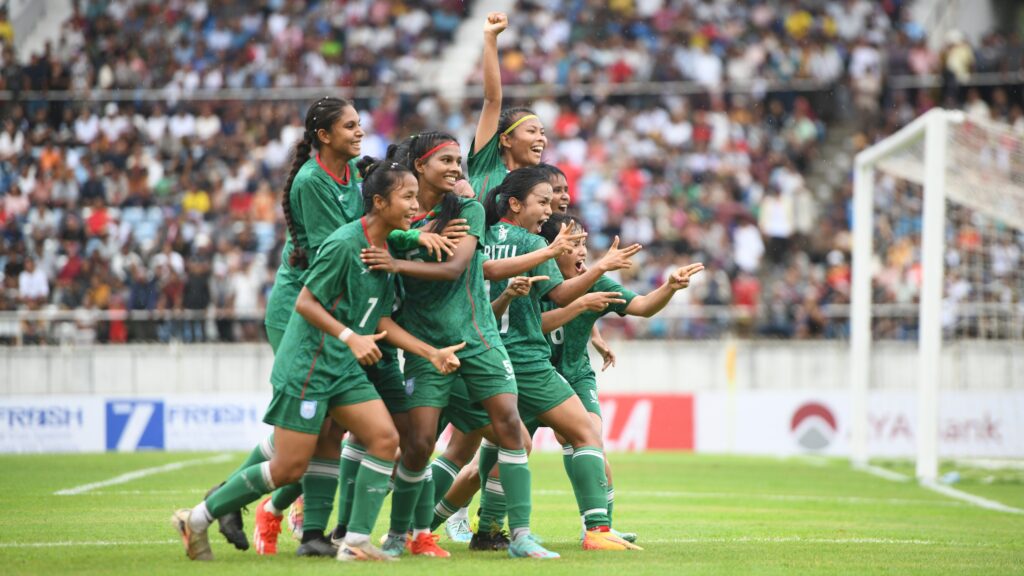
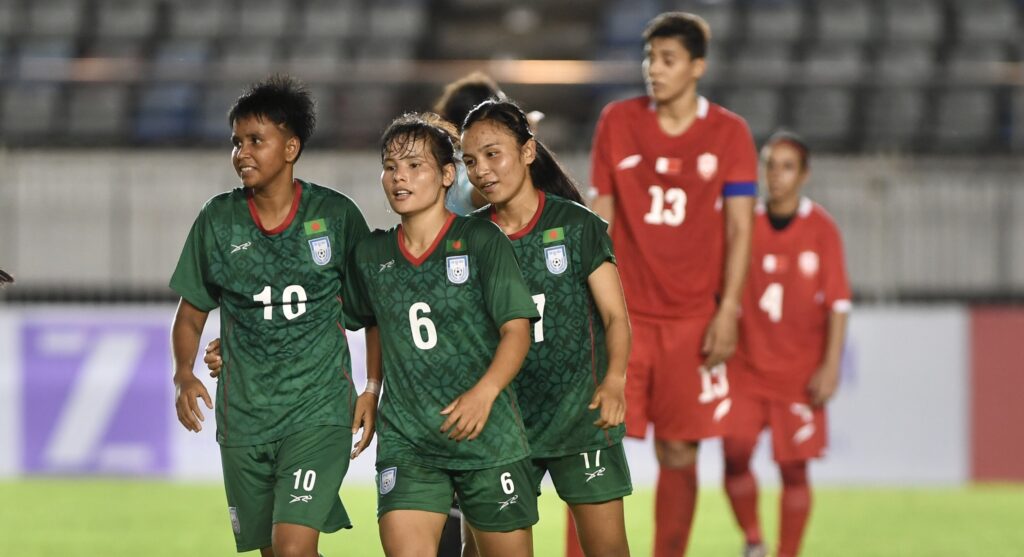
The Bengal Tigresses sealed their ticket to Australia with a 7-0 thrashing of Turkmenistan, with Monika scoring one of the goals as she reflected on that memorable night.
“After defeating Myanmar, our team had the confidence that we could produce good football against Turkmenistan. I’m happy to have my name on the scoresheet, but I actually love supplying assists more.”
However, since sealing qualification amongst the continent’s elite, the picture has looked completely different for the Bangladesh women’s national team leading up to the tournament.
Currently ranked 112 in the FIFA Women’s World Rankings, they have suffered defeats against the likes of Thailand and Malaysia — two teams who failed to qualify for the AFC Women’s Asian Cup.
Their last competitive fixture came back in December 2025 when they lost 2-1 to Azerbaijan. Local media have expressed frustration regarding the team’s preparations, citing neighbours India, who prepared by facing challenging European opposition in their preparatory camp in Turkiye.
In contrast, the Bangladeshi women had to be content by playing in the Bangladesh Women’s National League with serious question marks over the competitiveness in their domestic league. Nevertheless, Monika focused on the positives with Bangladesh’s opening group stage match now less than two weeks away.
“We continue to have training sessions and our team might still play some warmup matches,” cited Monika, with sources suggesting Western Sydney Wanderers could be a potential opponent for them when they land in Sydney.
“This season in our domestic league, all the big teams had several national team players. I also have the valuable experience of playing club football overseas for Paro FC last year.”
Show ‘em what you got!
In less than a fortnight’s time, the Bangladeshi women will step onto the pitch for the biggest moment in their careers. The tournament’s sole debutants couldn’t have asked for a tougher opening assignment, with defending champions China PR their first challenge at the Western Sydney Stadium on 3 March.
This will be followed by a meeting with DPR Korea at the same venue three days later, before they fly over to Perth to take on Uzbekistan in their final Group B fixture.
Former West Ham United midfielder Peter Butler will hope that his girls can display all that they have learned in this long journey when they arrive Down Under. In a bid to strengthen the squad, the 59-year-old Englishman has even added Sweden-born attacker Anika Rania Siddiqui to their travelling contingent.
“We are all extremely excited to arrive in Australia to compete in our maiden AFC Women’s Asian Cup. It will be a learning experience for us since we will face three big teams in the group stage,” said Monika, who had scored in the final of the 2024 SAFF Women’s Championship.
“We aim to showcase good football in Australia and that is the only objective that we have set for ourselves.”
Listen to From Dreams to Goals as we discuss the big issues ahead of kick-off of the AFC Women’s Asian Cup