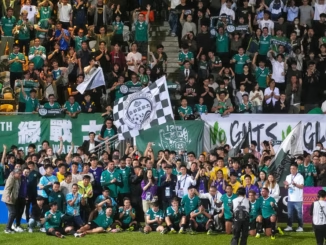
There was a time, not all that long ago, when momentum around Hong Kong football felt almost tangible.
A first AFC Asian Cup appearance in 55 years took them to Qatar in early 2024, where, despite three defeats to the UAE, Iran and Palestine in Group C, they emerged with a renewed sense of what might be possible.
Philip Chan was central to that moment, scoring Hong Kong’s only goal of the tournament against the UAE – which also happened to be the 1000th goal in Asian Cup history – a generation-defining moment for a player who has experienced almost every high and low Hong Kong football has had to offer.
Less than two years later, however, the mood could hardly be more different.
A 2-1 defeat to Singapore at the Kai Tak Stadium last November, despite taking a first-half lead, ended hopes of back-to-back Asian Cup appearances for the first time since the 1960s, before the campaign eventually petered out with a rather humbling defeat away to India in March.
Singapore instead claimed the solitary qualification berth from Group C.
For Chan, the disappointment of that moment is still being felt.

“Clearly everyone’s disappointed,” he told The Asian Game after Tai Po’s AFC Champions League Two defeat against Adelaide United last week.
“I would say it’s at a pretty, pretty low morale right now for Hong Kong football because we got kicked out of the Asian Cup qualifiers.
“So let’s hope we can turn it around, and this is where we start.”
The ‘this’ to which he refers is the inaugural FIFA ASEAN Cup.
Hong Kong, invited as one of three guest nations, will host Division Two of the newly created competition, facing Laos and Brunei in Group A at Kai Tak Stadium. The winner will progress to a final against the winner of Group B featuring Cambodia, Myanmar and Timor-Leste.
It is hardly a substitute for being at the Asian Cup in Saudi Arabia next January, but at the beginning of a new cycle, perhaps that is not what Hong Kong needs it to be.
“The ASEAN Cup is a great opportunity,” Chan said.
“Hopefully we can build from there, and it’s a good opportunity for the younger ones to really showcase themselves.”
Roberto ‘Chino’ Losada now has the responsibility of overseeing that rebuild.
The former Eastern coach stepped into the role on an interim basis following Ashley Westwood’s departure late last year, before being appointed permanently in June.
The Hong Kong Football Association has spoken openly about using this period to establish a clearer identity and placing greater emphasis on giving opportunities to younger players.

Chan believes the pieces exist.
“Chino’s been around for a while now,” he said. “(There’s) big potential in the squad. A lot of the younger ones are playing in higher leagues, and I’ve got high expectations for them.
“I think it’s a foothold for building something great in the future.”
That optimism is notable given how candid Chan has been about the state of Hong Kong football.
Two years ago he slammed the HKFA for not doing enough to develop the game in the territory.
“The players are doing their best, and some of the games are of a high standard,” he said, as quoted by the South China Morning Post.
“But we are all waiting for the day when the Hong Kong football ecosystem is healthier. “That does not come down to the players, or team [owners].
“I think the Hong Kong FA really needs to take a look at itself. They are not advanced enough, and have not lived up to expectations. They could be doing a much better job.”
They were stinging words from a senior player, but he also knows how important his voice, and that of other players is in pushing the game forward.

Speaking to The Asian Game before Tai Po’s clash with Adelaide, the 34-year-old identified the contradiction at the heart of the local game: Hong Kong continues to produce players capable of progressing beyond its borders, without its domestic structures necessarily developing at the same rate.
“We’ve produced a lot of quality players who are playing in top leagues in Asia, in China, and that’s a fact,” he said.
“But Hong Kong football itself, the league itself, has found difficulties in moving forward.”
There are, however, signs of encouragement.
“I have, actually,” he said when asked whether he had seen reason for optimism since those comments in 2024.
“There are a few teams who have introduced a little different element to the game. They pretty much turn the game into a carnival, like a show, which really attracted a significant amount of attendance.
“They’re trying to move stuff forward, and a big round of applause to them and big credit to them.”
The challenge is turning isolated signs of progress into something sustainable.
The veteran midfielder is wary of placing responsibility on one coach, one administration or any single group of players. The problems, in his view, sit deeper.
“It’s not something that one person can change,” he said. “It’s a whole cultural thing.”
He points instead towards the wider football infrastructure and whether it is doing enough to support the talent Hong Kong continues to produce.

“So many of our young talents have shown what they’re capable of,” Chan said.
“They’ve gone, they’ve flown really high and they’ve done us proud. I would say the infrastructure, has it given them what they deserve?”
Those are questions that will not be answered over the course of two group matches and a possible final over the next fortnight.
Nor will beating Laos or Brunei erase the disappointment of missing another Asian Cup.
But that is perhaps where the value of this ASEAN Cup lies for Hong Kong.
At home, against opposition around their own level, Losada has an opportunity to expose younger players to competitive international football, begin shaping an identity and, perhaps most importantly, restore some belief after a bruising end to the previous cycle.
The destination remains the Asian Cup and, beyond that, another attempt at breaking new ground in World Cup qualification.
For now, Hong Kong simply needs somewhere to begin. The ASEAN Cup offers them that foothold.