
Tai Po is a club that means many things to many people.
For coach Lee Chi-kin, it is where his coaching career really began to flourish. For veteran midfielder Philip Chan, it is the feeling of playing for something bigger than yourself.
But for the district whose name the club carries, Tai Po means something more again.
Never was that bond more painfully evident than last November, when Tai Po – the place, not the football club – suddenly became international news for all the wrong reasons.
The team was thousands of kilometres away in Australia, preparing for an AFC Champions League Two encounter with Macarthur FC, when fire tore through Wang Fuk Court back home.
What initially appeared to the players to be a relatively small fire escalated with terrifying speed. By the time its true scale became clear, 168 people had lost their lives in Hong Kong’s deadliest fire in decades.
And this was no distant tragedy for Tai Po Football Club.
The team trains at Kwong Fuk, directly opposite Wang Fuk Court. Goalkeeper Tse Ka-wing, who has lived in Tai Po for years, said at the time that he regularly walked past the estate.

In Campbelltown, the players could do little but watch events unfold from afar.
“It escalated so quickly, we didn’t have time to react,” Chan recalled. “It was the day before the game. I remember it now, it was pretty much like yesterday when it happened.”
A minute’s silence was observed before kick-off, Tai Po’s players wore black armbands, and when they scored to take a shock early lead, there was no celebration.
How could there be? Back home, their community was grieving.
“We were playing kind of on behalf of Hong Kong,” Chan told The Asian Game just hours after Tai Po arrived in Adelaide for another continental campaign.
What followed did not erase the pain, with Chan saying it remains with the players even now.
“The pain is still there, but it’s buried somewhere,” he said. “We kind of transform that into a kind of energy.”
That energy carried Tai Po through the remainder of a season in which they would win two domestic cups – the FA Cup and Senior Shield – and only narrowly miss out on qualification for the knockout rounds of ACL Two.
Chan, a thoughtful and considered voice, was careful with his words so as not to portray football as some cure for tragedy, but he believes the experience tightened bonds already deeply embedded between the club and its district.
“I thought the whole fire incident kind of gave us motivation rather than took us down,” he said. “We felt like we were more united. There was a sense of unity after that.”

State of flux
For Tai Po, rebuilding is hardly an unfamiliar experience.
Though the circumstances are incomparable, the idea of enduring hardship and beginning again runs through the history of the football club, too.
That history began only this century, formed as one of 18 district clubs in 2002 as part of a push from the Hong Kong government to develop local identity and foster ties between local communities and sport.
This season, six of those 18 district teams will compete in the Hong Kong Premier League, mixed with ‘commercial’ teams that aren’t linked to a geographical location, and have historically been the strongest teams in the city-state; teams such as Kitchee and Lee Man, for example.
Tai Po started life in the newly created Third District Division and rapidly climbed the pyramid, reaching the old First Division by 2006. The journey since has rarely been straightforward.
They dropped in and out of the top flight during the following decade before reaching their first great peak in 2018/19, when they became the first district club to win the Hong Kong Premier League.
Barely a year later, with the financial impact of the COVID-19 pandemic biting, they withdrew from the competition and ‘self-relegated’ to the second tier.
Their first season back was grim – two wins from 13 matches and a 13th-place finish – before the next campaign brought a dramatic reversal. Tai Po were top after 13 games when the season was abandoned and were subsequently promoted back to the Premier League.
Three years later, they were champions again.

And yet, in a mirror of the last time they won the title, the club is again facing an uncertain future with the Yip family, the club’s major financiers, expected to walk away at season’s end, once again placing the future of the club in doubt.
For Lee Chi-kin, though, Tai Po’s value has never been measured solely in balance sheets or league tables.
“Some of the fans, or the players, were born in Tai Po, studied in Tai Po,” he explained to The Asian Game. “Saturday or Sunday when we have a game, they will come to support us like a family.
Despite prior experience at other clubs, Tai Po is also where Lee says his own coaching career began.
“For me, I love Tai Po.”
But he is also realistic as to the current landscape, explaining to The Asian Game that after their recent success, and with financial limitations, the club saw more than half of their list move on at the end of last season.
This, he says, is part of the natural life-cycle of district clubs who cannot compete financially with the league’s commercial teams.
“To be honest, I think this is not only Tai Po… district teams are always like this,” he explained.
“We always say that district teams are different compared with traditional clubs with backing – you know, Kitchee, Lee Man, a lot of different clubs.
“District teams have some resources from the government, but it is difficult to stay [at the same level] for a long time. Maybe for two or three years we develop, and then things can change again because the situation is different.
“When [players] are successful, when they get achievements, players need to look for something better. Then they will leave, and when they leave, it is difficult because we don’t have good money to hold some of the quality players.
“So we need time, maybe two or three years again.”

Community Connection
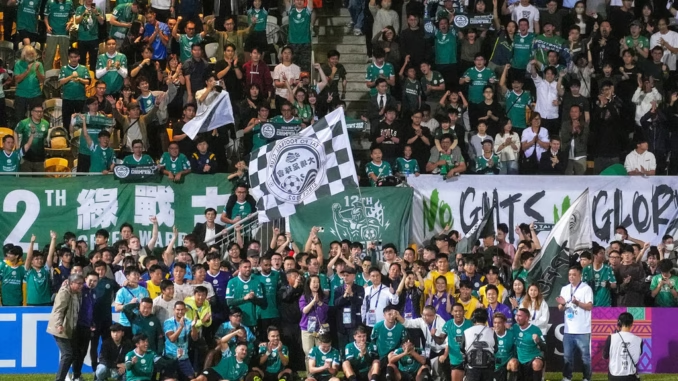
Despite the hardships, the one thing that never waivers is the spirit of the fans and that connection between community and club.
The money may come and go. Players may leave, and entire teams may need rebuilding. Throughout it all, however, the supporters remain.
Some have even followed Tai Po all the way to Adelaide this week.
“You see the fans who came all the way here to Adelaide. They’ve been with the club for years and years,” Chan said.
“They wouldn’t be following an individual, like a player. They would be following the club, and they would love the club with all their heart, and they would come here even if they have to change four flights and it takes two days.
“For me, that’s one of the main things where we feel connected in some way.”
While they may not have the wealth of other clubs, their richness comes in the form of that special bond.
“When you play for a traditional club, it depends more on the direction of the club and what the owner at that time really wants,” said Chan, who scored Hong Kong’s only goal at the 2023 AFC Asian Cup.
“But for a district club like us, we always have to look at it from more of a community base.

“Every time we go out and perform, with whatever we do, every one of our actions, we kind of have to be responsible for it towards the community.
“Tai Po is a pretty popular place and most of our fans, most of our support, comes from the community. So we’re not just looking at the boss, or the board, or the owner. We’re looking at the bigger picture.
“For me, that’s something different.”
He continued: “It would be a shame if I left the club and played for another club. I would feel bad. I would feel like I can’t betray them or cut that connection loose.
“If you play for a regular club, the sense of belonging wouldn’t be as strong. You feel like you play for yourself. You feel like you’re playing for the contract. You feel like you’re doing it for yourself – which is normal. There’s no right or wrong about either situation.
“But playing for this district club, I would say the sense of belonging amplifies a bit.”
On Thursday night, they will begin another continental journey, carrying the name of their district on their shirt and in their hearts.
The last time they were in Australia, their community was thrust into the international spotlight. The charred Wang Fuk Court still stands next to their training ground, a daily reminder of what their community has endured.

“We want to give the club every chance of bringing more joy to the district,” Francis Yip said in March, just a few short months after the disaster.
For Tai Po, perhaps that is the point.
Trophies come and go. Players move on. Money ebbs and flows. The club has fallen, rebuilt and risen again.
But the name on the shirt remains the same – and so does the community behind it.


