EXPLORE THE ASIAN GAME
Football through an Asian lens.

With the Asian Cup less than three months away, FIFA’s expanded two-week window offered a revealing test across the continent. Indonesia, Australia and Palestine emerged with momentum, while South Korea, China and Iran were left with increasingly uncomfortable questions before Riyadh.
FIFA’s inaugural expanded two-week international window offered the perfect opportunity for Asia’s national teams to advance their preparations ahead of the upcoming AFC Asian Cup, now less than three months away.
There were notable successes, from the Gulf Cup, to the inaugural FIFA ASEAN Cup, however, elsewhere across Asia, a number of nations struggled to make the most of the extended window, leaving questions over how effectively they’ve used the increased preparation time available.
There were contrasting stories across the continent. While the visit of Brazil increased attendances and provided a yard stick of the development in Australia and India, unfortunately old habits remained lazily predictable in East Asia, with the usual array of South American guest slots rocking up for largely forgettable and less than fit for purpose tests for Japan and Korea Republic.
The window provided opportunity for some, but a dose of reality for others. As the Road to Riyadh nears its completion, an understanding of the winners and losers from the last two weeks starts to frame the narrative of what to expect at the continental showpiece at the turn of the year.
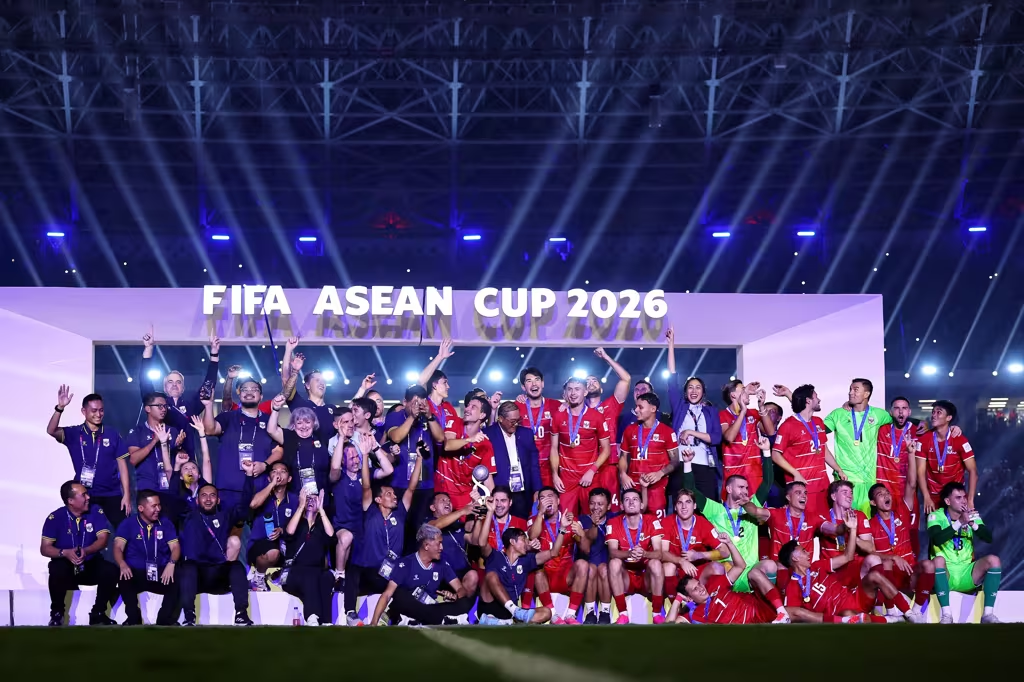
Despite the controversy and mayhem that surrounded its build-up, the inaugural FIFA ASEAN Cup may hopefully be remembered for the exciting finale offered up on the pitch. For Indonesia at least, it provided the perfect memento, with the Garuda claiming their first senior title after overcoming Thailand in Monday’s final.
There was certainly an element of fortune about the title victory. Two controversial stoppage-time goals helped Indonesia edge past Bangladesh on route to the final, while a late equaliser in extra time forced a penalty shootout in the final. Yet the near misses tell only one side of the story, as Indonesia consistently demonstrated the attacking quality and depth that has seen them rise in prominence over the last few years.
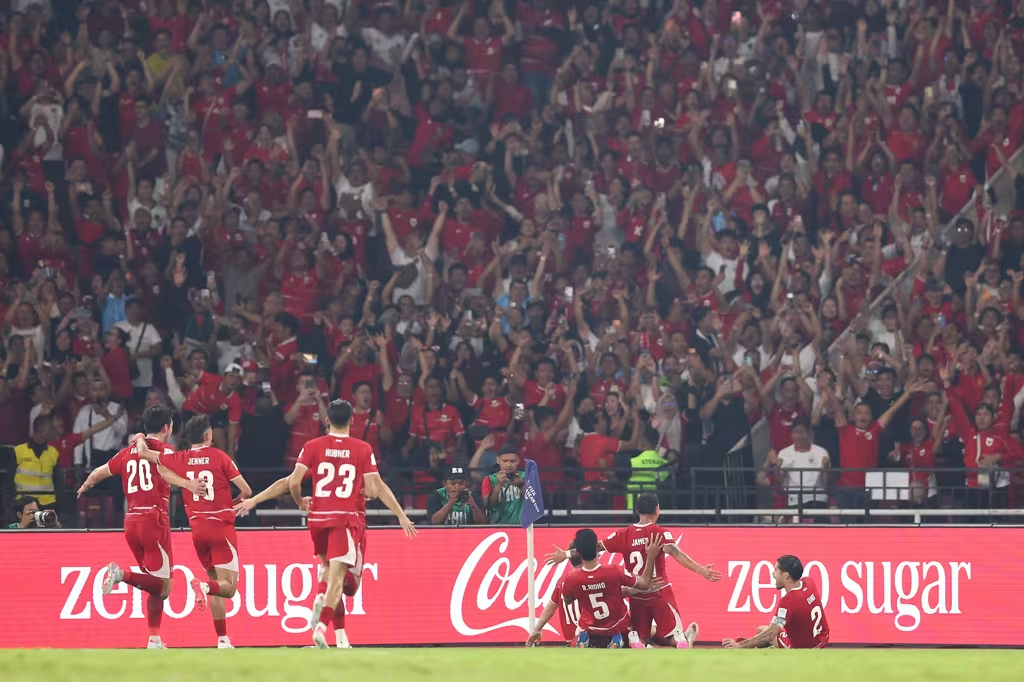
Just two months after their disappointing group-stage exit from the AFF Hyundai Cup, the ASEAN Cup offered an immediate opportunity to recover and reassert their regional standing. With 12 squad players based outside Southeast Asia, Indonesia were among those best positioned to benefit from the official window scheduling, something they demonstrated immediately by beating Singapore, the same side who had eliminated them weeks earlier.
Elkan Baggott and Justin Hubner strengthened the defence, while Ole Romeny offered greater creativity and nuisance value in attack. But it was teenager Mitchell Baker who again caught the eye in front of goal. One of the few bright spots in Indonesia’s doomed Hyundai Cup campaign, the striker developed an effective understanding with Romeny throughout the tournament, highlighted by his five-goal Manita against Bangladesh.
The tournament may have split opinions on its future validity or place in the wider football calendar, but Indonesia’s success also underlines the opportunity available if Southeast Asia can better align its schedule with the availability of overseas-based players.
While they didn’t come away with anything to show for it in terms of a victory, it’s hard to take anything but positives away from Australia’s two-game series against Brazil.
Australia were one team that decided to play just two games in this four-game window, but after departing North America with many questions hanging over their heads, the faithful down under will be feeling a lot better about the direction of the side under Tony Popovic.
Playing Brazil is never easy – just ask Japan – and while the Selecao had moments of domination, particularly at the start of the second game in Brisbane where they scored inside of two minutes, Australia showed much more intent to take the game on than they did at the World Cup and were rewarded for it.
Nestory Irankunda underlined why he will become the poster boy for this generation with a stunning goal, and an overall impressive performance in the opening game, while the evolution of Paul Okon-Engstler in midfield continues at rapid speed. It’s hard to imagine the Socceroos engine room without him now.

The biggest question that remains is that of personnel, with key stars in Mo Toure and Jordy Bos and facing a race against time to be fit for the Asian Cup in January.
Looking ahead to the tournament, however, Australia were already going to enter the tournament as one of the more fancied sides, and after the performances of this window, their stock has only risen.
A simple game of word association for Palestine’s national team is most likely to turn up the following: gritty, fighters, difficult. Most fans would not associate free-flowing attack with Al-Fida’i but that might be about to change following an international window that featured eleven goals in three games including a 5-0 demolition of two time Asian Cup finalists China in Chongqing.
Just fifteen years ago Palestine suffered its heaviest defeat in a friendly in Tehran when Iran posted a 7-0 victory in a game where they could have easily hit double digits. It has been a steady upward trajectory since then. The side qualified to its first Asian Cup two-and-a-half years later and will now make a fourth consecutive trip next January. Each campaign has seen steady improvement but Palestine have been underdogs in every single one of their ten matches at the continental finals. That will change this winter in Saudi Arabia as they’ll be expected to push the hosts for top spot in Group A in an all-Arab group containing Oman and Kuwait.

Since his first match in March 2025, manager Ehab Abu Jazar has capped twenty new players whilst retaining the core of the side that reached new heights during the last cycle. He has also given Oday Dabbagh a new lease on life in a free role on the right wing, and the Zamalek star responded with four goals in the last three games; Assad Al-Hamlawi – who now starts because Wessam Abou Ali is out with an ACL tear – has five, while Zaid Qunbar has dished out three assists to his teammates in that time.
Palestine still have a lack of depth at centre back but with one of Asia’s best goalkeepers in Rami Hamadi (34 clean sheets in 67 matches) Al-Fida’i have all the makings of a side primed for a tournament run.

The post-World Cup bounce has yet to materialise for Korea Republic, with interim coach Robert Moreno’s first four matches of his six-game audition providing little evidence that the side is ready to compete at next year’s Asian Cup. The Spaniard’s opening window was disjointed, occasionally fractious, and ultimately, underwhelming. Months on from the fallout surrounding Hong Myung-bo’s departure, Korea’s hopes heading into January appear remarkably fragile.
They can at least point to bookended victories over Ecuador and Uzbekistan, with the developing partnership between Oh Hyeon-gyu and Son Heung-min offering Moreno something to build around, even if neither performance was entirely convincing. In between, came a heavy defeat to Uruguay and a drab goalless draw with Venezuela, exposing familiar shortcomings and a worrying lack of attacking imagination.
There was also an uncomfortable predictability to another home window built around South American opposition. It may be useful for confidence when results are positive, but it does little to disguise the scale of reform required within Korean football.
More concerning was the mood around the squad. Public disagreements on the bench, frustrated body language and critical comments from players all pointed towards a group in flux. With reports suggesting the international futures of established pillars including Kim Min-jae, Hwang Hee-chan and Hwang In-beom could soon be in doubt, the KFA’s transition may be about to accelerate.
There is work to do, and plenty of it, which Moreno and the KFA might have preferred to undertake away from the intense scrutiny of the Korean faithful. Another Asian Games success in Japan offers at least a glimmer of success to build some optimism heading into November.

If the contradiction at the heart of Chinese football was the central theme of our piece ‘Hope and Despair’ earlier this week, the senior national team offered a rather stark reminder of the latter.
With the Asian Cup now only months away, China opted against accepting a guest place in the ASEAN Cup, instead staying at home, with a more experimental squad to prepare away from the international spotlight. A decision to avoid difficult questions on a continental platform at a time of rebuild may be wise, but three successive defeats have ensured the scrutiny has arrived at their door anyway.
Despite a modest victory over the Maldives, crushing defeats to New Zealand, Palestine and Tajikistan, leaves Shao Jiayi’s attempts to rebuild a national team still searching for direction. While the defeats were one thing; it was the manner and the symbolism that will live longer in the mind.
The 3-0 defeat to New Zealand was effectively a walkover for the All Whites, while the 5-0 loss to Palestine was historic in its scale, only increasing the widespread public dismay and renewed calls for change. A response was required, but instead, China followed it with a 1-0 defeat to a Tajikistan side itself undergoing a difficult period of transition under Igor Angelovski. Weak, lacking urgency and authority; the team represented a squad without strong leadership or drive to change.
The boos and examples of individual frustration at Longxing Stadium told their own story. While there are genuine reasons for optimism elsewhere in Chinese football, this current national team remains firmly on the wrong side of that divide. The future may yet be brighter, but getting there, might take considerably longer than hoped.

The conclusion of the Asian Cup will mark the four-year anniversary of Amir Ghalenoei’s recent tenure in charge of Iran. Having taken over from Carlos Queiroz following the World Cup in Qatar, Ghalenoei’s critics have been quick to ask whether he’s moved the squad forward over that time; an all too familiar critique, after another dismal international window this week.
Back then, the team needed to regenerate, transition quickly to a younger generation, having been solely reliant on a so-called golden generation over the last two decades. That transition has been assumed to be a formality after each of the last few tournaments, however the stubborn resistance to move on from the older guard has held them back from moving on. Of the players that started Ghalenoei’s first match in charge against Russia in early 2023, seven remain bedrocks of the squad that played this window; including Ramin Rezaeian and Ehsan Hajsafi and Shojae Khalilzadeh, all of whom are over 36.
It was a predictable set of foes ahead of them this window; failing again to beat Central Asian neighbours Uzbekistan for a seventh game in a row, going down 3-1 in Fergana, before being outclassed by Russia in Kazan. A fitting point for introspection, three months out from an Asian Cup where few, even Ghalenoei, can claim to truly have hopes of contending for the title. The squad lacks vibrancy and pace, odd having left playmaker Mehdi Ghayedi, forward Allahyar Sayyadmanesh out of the squad, in what seems to be more of a personality clash than an issue over ability.
The pressure is growing on Ghalenoei, but one shrugs the shoulders and feels an inevitable narrative playing out; a ever-diminishing hope that they can pull off another back-against the wall display similar to that on display in North America over the summer.
with Bassil Mikdadi and Paul Williams